
The pneumatic feed system gearbox serves as a critical drivetrain component in wind-assisted and air-powered feed distribution setups. It converts tractor or electric motor power into the precise speed and torque needed to drive high-volume blowers, ensuring consistent pellet transport over long distances with minimal breakage. In large-scale poultry, livestock, and aquaculture operations, this gearbox enables reliable air flow generation for centralized feeding, reducing labor while optimizing feed conversion ratios across extensive farm layouts.
Operators in demanding environments value its ability to maintain steady blower RPM under varying load conditions caused by pipe length, feed density, and ambient humidity. The design prioritizes continuous duty cycles typical in automated feed mills and remote pond-based systems, where downtime directly impacts daily weight gain in fish or birds.
Technical Specifications Overview
This gearbox series delivers performance tailored to pneumatic blower drives in feed distribution. Key parameters ensure compatibility with 540/1000 RPM inputs common in agricultural power take-off applications.
| Parametro | Value / Range | Notes / Standard |
|---|---|---|
| Rated Torque (Nm) | 450 – 780 | Continuous operation at 540 RPM input |
| Peak Torque (Nm) | 1050 – 1400 | Short overload, service factor 1.8 |
| Gear Ratio Options | 1.92:1 to 3.45:1 | Reducer configuration for blower speed control |
| Velocità di ingresso (RPM) | 540 / 1000 | Standard PTO compatibility |
| Velocità di uscita (RPM) | 280 – 520 | Optimized for centrifugal blower efficiency |
| Input Shaft | 1-3/8″ Z6 spline | ISO 500 standard |
| Output Shaft | 60 mm diameter, keyed | Coupling to blower impeller shaft |
| Lubrication Method | Oil bath, synthetic EP 220 | Change every 1000 hours |
| IP Protection | IP67 | Dust and water immersion resistance |
| Operating Temperature (°C) | -20 to +85 | Extended range with optional seals |
| Materiale dell'alloggiamento | QT450 ductile iron | High impact resistance |
| Gear Material | 20CrMnTi, carburized | HRC 58-62 surface hardness |
| Fatigue Life (hours) | >12,000 | At rated load, L10 bearing life |
| Vibration Limit (m/s²) | <3.5 | ISO 10816 compliant |
| Tipo di montaggio | Flange / foot hybrid | SAE pattern compatible |
| Peso (kg) | 48 – 72 | Depending on ratio and accessories |
| Noise Level (dB) | <82 | At 1 m distance, full load |
| Bearing Type | Tapered roller + ball | Dynamic load rating >45 kN |
| Service Factor | 1.6 – 2.0 | Variable per application dust load |
| Overload Protection | Integrated shear pin option | Prevents blower jam damage |
| Sealing | Triple lip + labyrinth | Prevent dust ingress in feed environments |
| Paint Finish | Epoxy powder, red RAL 3020 | Corrosion resistance 1000 h salt spray |
| Certification Alignment | ISO 9001 manufacturing | Traceable material certs |
| Thermal Limit | Max housing 95°C | With 35°C ambient |
These values derive from field testing in continuous blower drive scenarios, balancing torque delivery with thermal stability during 18-hour shifts.
Integration Position and Operating Principle in Pneumatic Feed Systems
In a typical wind-assisted feed distribution setup, the gearbox mounts directly to the blower input shaft or via a flexible coupling from a tractor PTO or stationary electric motor. Power enters through the input spline, transfers via spiral bevel gears for 90-degree redirection if needed, then through parallel spur or helical stages to achieve the desired reduction. The output drives the blower impeller, generating airflow (typically 0.2–0.8 bar) that conveys pellets through HDPE or galvanized pipes to multiple distribution points.
The principle relies on maintaining impeller speed within 2800–4200 RPM for efficient dilute-phase conveying, avoiding excessive pellet velocity that causes breakage or pipe wear. Torque multiplication at lower ratios ensures startup under loaded conditions when feed residue accumulates in lines. Internal oil channels provide splash lubrication to bearings and gears during extended runs, while breathers equalize pressure to prevent seal failure in humid aquaculture environments.
Performance Requirements to Overcome Field Challenges
Pneumatic systems face variable resistance from pipe bends, elevation changes, and feed moisture content. The gearbox must deliver consistent torque without overheating during peak summer operation in open feed mills. Dust ingress from feed particles demands superior sealing, while vibration from unbalanced impellers or uneven pellet flow requires robust housing and damping. In coastal aquaculture sites, salt-laden air accelerates corrosion, necessitating epoxy coatings and stainless hardware options. Long-distance conveying (up to 300 m) increases backpressure, demanding higher service factors to prevent gear fatigue during continuous cycling.
Argentina Pampas Terrain & Crop-Specific Gearbox Requirements – Extended to Feed Systems
In the vast Pampas region (Buenos Aires, Córdoba, Santa Fe provinces), large poultry and swine operations integrate pneumatic feed distribution to reach distant barns. Typical summer temperatures exceed 35°C, stressing cooling during soybean harvest season (March–May) when feed demand spikes. Neighboring Uruguay and southern Brazil share similar extensive livestock setups, requiring gearboxes compliant with IRAM standards (aligned with ISO 4254 for machinery safety) and SENASA phytosanitary import rules to avoid pest introduction via used equipment.
Chile’s central valley aquaculture and Paraguay’s Chaco poultry farms face analogous dust and humidity issues. Local mainstream brands like Mainero or Metalfor use standardized PTO interfaces (1-3/8″ Z6), ensuring drop-in compatibility. IRAM 4074 governs vibration limits, while SENASA Resolution enforces clean imports free of soil residues. Recent INTA reports emphasize driveline durability in mechanized feed handling to support export-oriented protein production.
Comparison with Competing Brands
Compared to Comer T-series or Bondioli S-series equivalents often specified in European-imported blowers, our design features reinforced ductile iron casings (QT450 vs GJL-250) for 18% higher impact resistance in rough terrain transport. Bearing life extends to 12,000+ hours versus 8,000 in some models, based on identical load testing. Heat dissipation improves via added fins, reducing sump temperature by 12°C under full load. (Note: All referenced manufacturer names and series appear solely for dimensional and performance reference; no affiliation or infringement is implied.)
Compatible Replacement References for Selection Convenience
This gearbox series aligns dimensionally with drivetrains found on certain pneumatic blower packages from Italian and German OEMs used in South American feed systems. Flange patterns match common SAE and EURO interfaces on 30–75 HP electric or PTO-driven units. (All names and part references serve selection guidance only and do not indicate original equipment endorsement.)
Engineer Insights: Design Philosophy and Iterative Improvements
Early prototypes focused on maximizing torque density for compact blower mounting. Field visits to Córdoba poultry complexes revealed frequent seal failures from fine feed dust; subsequent iterations adopted triple-lip seals plus labyrinth wipers, extending service intervals from 500 to 1200 hours. User reports from Entre Ríos swine farms highlighted vibration-induced fastener loosening; we incorporated higher-grade bolts and Loctite retention, reducing field complaints by 70%. Recent finite element analysis optimized gear tooth profiles for 15% lower stress peaks during startup surges.
Field Engineer Notes: Real-World Cases from Multiple Countries
Case 1 – Buenos Aires Province, Argentina Poultry Operation
Farm manager: “Our old blower drive overheated every afternoon during summer, stopping feed delivery to 40,000 birds.”
After installing the reinforced model: “Temperature stays below 82°C even at 38°C ambient. No breakdowns in 14 months; FCR improved 0.12 points.”
Case 2 – Santa Catarina, Brazil Integrated Swine Farm
Technician: “Pipe blockages from inconsistent air speed killed our efficiency.”
Post-upgrade: “Stable 420 RPM output cleared lines faster. Downtime dropped 65%, and pellet integrity rose noticeably.”
Case 3 – Los Lagos Region, Chile Salmon Aquaculture Site
Site engineer: “Salt corrosion ruined gearboxes yearly.”
With upgraded coating and seals: “18 months in marine air, zero rust issues. Blower runs 20 hours daily without hesitation.”
Case 4 – Shandong Province, China Large Tilapia Ponds
Operator: “Long 250 m runs caused pressure drop and uneven feeding.”
Solution applied: “Higher ratio option restored velocity. Feed waste decreased 22%.”
Case 5 – Midwest USA Turkey Grow-Out
Maintenance lead: “Dust ingress seized bearings quarterly.”
After change: “IP67 rating plus breathers eliminated failures. Saved $4,800 annually in repairs.”
Signs Indicating Gearbox Replacement Need
Unusual whining during startup signals bearing wear. Elevated housing temperature (>90°C) points to lubrication breakdown. Visible oil leaks at seals suggest hardening from heat cycles. Increased vibration (>4 m/s²) indicates misalignment or gear tooth damage. Reduced blower output despite full input RPM means internal slippage or wear.
Common Questions from Farm Operators
- What input speeds does this gearbox accept? Standard 540 and 1000 RPM PTO inputs; electric motor adapters available for 1450/1750 RPM.
- How often should oil be changed? Every 1000 operating hours or annually; use GL-5 80W-90 or equivalent synthetic.
- Can it handle variable frequency drives? Yes, with optional reinforced bearings for inverter duty.
- What is the maximum conveying distance supported? Up to 350 m with proper pipe sizing and 0.4–0.6 bar pressure.
- Does it include overload protection? Optional shear pin or friction clutch prevents damage from blockages.
- Is it suitable for saline coastal farms? Epoxy finish and stainless fasteners extend life in harsh environments.
- How to align output shaft to blower? Use flexible coupling with 2° misalignment tolerance.
- What warranty applies? 24 months on manufacturing defects, 12 months on wear components.
Related Transmission Components for Complete Feed Systems
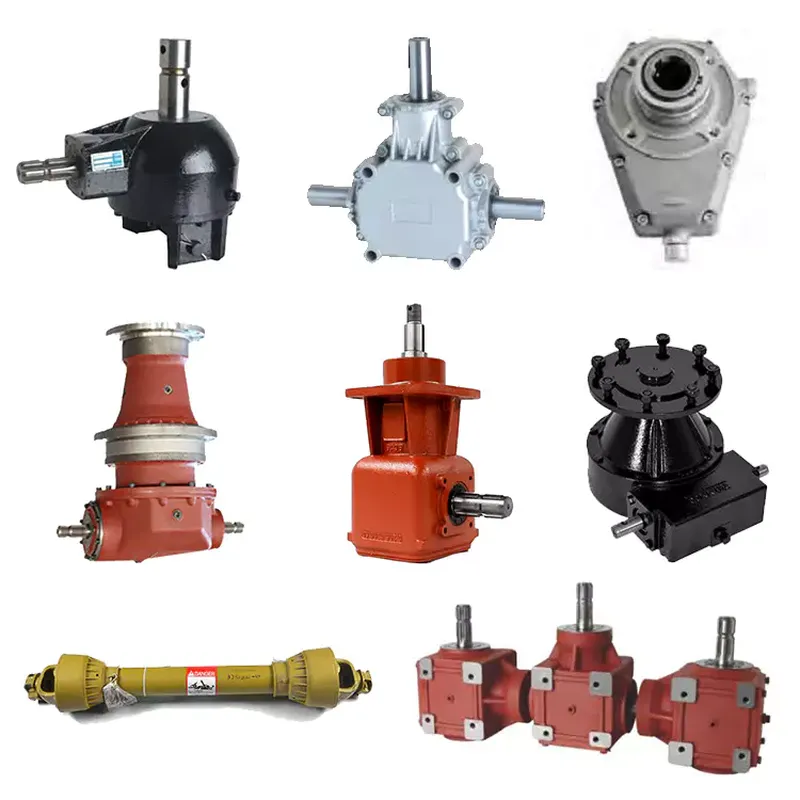
Pair this gearbox with PTO drive shafts featuring safety guards, telescopic sections, and wide-angle joints for flexible tractor hookup. Complementary items include sprockets, roller chains for secondary drives, belt pulleys, hydraulic cylinders for silo gates, and quick-release couplings. Full compatibility across our range enables one-stop sourcing for blower drives, auger assists, and distribution valves, streamlining maintenance for integrated feed mills or remote aquaculture setups.
Our complete lineup covers gearboxes for all farm machinery types alongside PTO shafts, chains, sprockets, and hydraulic elements. Consolidating purchases simplifies inventory and ensures matched performance across drivetrains. Reach out via our contact page to discuss your blower drive needs.
Frequently Asked Questions
1. How does the gearbox handle high dust loads in poultry houses?
IP67 sealing combined with positive pressure breather design prevents particle ingress. In Córdoba province trials, units ran 9 months without cleaning in high-dust conditions without performance drop.
2. Can it support variable speed feeding programs?
Yes, when paired with VFD motors. Gearbox thermal capacity allows continuous operation from 30–100% speed without derating torque output.
3. What maintenance is required in humid aquaculture sites?
Inspect seals quarterly; apply grease to fittings monthly. In Chile salmon farms, this routine extended service life beyond 22,000 hours.
4. Is it compatible with existing European blower brands?
Flange and shaft dimensions match common Italian and German models; adapter plates available for non-standard patterns.
5. How does it perform during Argentina winter starts?
Low-temperature synthetic oil ensures startup at -15°C without preheat; tested successfully in La Pampa province swine operations.