
Descrição do produto
Descrição do produto
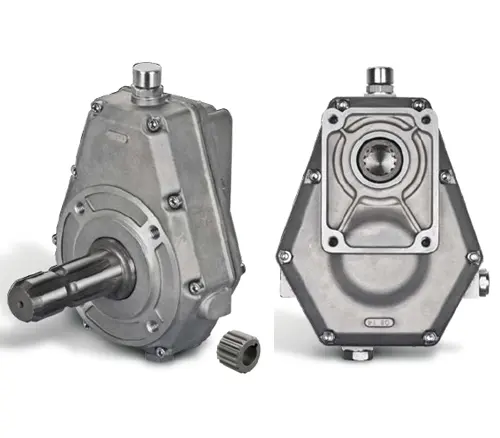
PTO gearboxes are designed for connecting pumps, motors, and other actuators.
·The gears and shafts of gearboxes are all use high strength alloy steel, they own great toughness and wear resistance through the corresponding processing and heat treatment.
·The covers and housings are made in shell-cast aluminium or cast iron, and the material density, strength and appearance are very good, you can choose the gearbox of different materials according to the power or torque you use.
·All machining parts are CNC lathe, CNC hobbing machine, CNC shaving machine, machining center and other precision machine tools for processing, They can guarantee the dimensional accuracy of each part very well.
·Other parts all meet the corresponding national standards, they have excellent performance and long service life.
Fotos detalhadas
Parâmetros do produto
| Input torque (Nm) | Output torque (Nm) | Input speed (r/min) | Transmission ratio | Output speed (r/min) | Poder (Kw) | Peso (Kg) |
| 380 | 260 | 540 | 1.5 | 810 | 20 | 9.7 |
| 430 | 210 | 540 | 2 | 1080 | 20 | 9.7 |
| 460 | 180 | 540 | 2.5 | 1350 | 20 | 9.7 |
| 490 | 160 | 540 | 3 | 1620 | 20 | 9.7 |
| 460 | 130 | 540 | 3.5 | 1836 | 20 | 9.7 |
| 437 | 115 | 540 | 3.8 | 2052 | 20 | 9.7 |
perfil de companhia
ZheJiang Ding’an Hydraulic Machinery Co., Ltd. is a professional company integrating the research, production and sales of hydraulic valves. It is an ISO9001:2000 quality management system certified enterprise. The company currently has fixed assets of more than 10 million yuan, covers an area of 16,000 square meters, has strong technical force, and has more than 10 years of experience in the development and production of hydraulic valves. It can quickly and high-quality develop various mining and engineering machinery hydraulic valves according to customer requirements.
/* 22 de outubro de 2571 15:47:17 */(()=>{function d(e,r){var a,o={};try{e&&e.split(“”,).forEach(function(e,t){e&&(a=e.match(/(.*?):(.*)$/))&&1
Efficient Power Transmission and Torque Transfer with Miter Gearboxes
Miter gearboxes play a crucial role in ensuring efficient power transmission and torque transfer in mechanical systems:
Direct 90-Degree Motion Change: Miter gearboxes utilize bevel gears to change the direction of rotational motion by 90 degrees. This direct motion change eliminates the need for additional components or complex transmission mechanisms, resulting in minimal power losses.
Optimal Torque Transfer: Bevel gears in miter gearboxes are designed to mesh at a specific angle, allowing for efficient torque transfer between the input and output shafts. This design ensures that a significant portion of the input torque is transmitted to the output shaft, minimizing energy wastage.
Sturdy and Precise Gearing: Miter gearboxes are constructed with high-quality materials and precision machining to ensure proper meshing and engagement of the bevel gears. This enhances the gearbox’s ability to transmit torque accurately and reliably.
Reduced Friction and Wear: The meshing bevel gears in miter gearboxes are engineered for minimal friction and wear. This feature contributes to efficient power transmission over the gearbox’s lifespan and helps maintain consistent torque transfer.
Compact and Space-Efficient Design: The compact nature of miter gearboxes allows for efficient use of available space in mechanical systems. This design minimizes the distance between the input and output shafts, reducing potential energy losses and improving overall efficiency.
Applications in High-Torque Scenarios: Miter gearboxes are often employed in applications requiring high torque transmission, such as heavy machinery, industrial equipment, and automotive systems. Their ability to efficiently handle torque transfer makes them suitable for demanding tasks.
Versatility and Customization: Miter gearboxes can be customized to meet specific torque and power requirements of different applications. This adaptability ensures optimal torque transfer and power transmission in various settings.
Overall, miter gearboxes are designed to provide efficient and reliable power transmission while maintaining high torque transfer capabilities, making them valuable components in a wide range of mechanical systems.
Miter Gearboxes in Robotics and Automation Applications
Miter gearboxes are indeed utilized in robotics and automation applications, leveraging their unique capabilities for precise motion control and direction change:
Precision Motion: In robotics, miter gearboxes can be employed to achieve precise and accurate motion at right angles, allowing robots to perform intricate tasks with accuracy.
Joint and Arm Movements: Robotic arms often require precise movement and control at various angles. Miter gearboxes enable smooth and controlled motion changes, contributing to the versatility of robotic arms.
Direction Change: Many automation systems involve the need to change the direction of motion, such as conveyors or assembly lines. Miter gearboxes efficiently handle these changes, ensuring seamless operation.
Space Optimization: Robots and automated systems often operate in confined spaces. Miter gearboxes’ compact design makes them suitable for integrating into space-constrained environments.
Responsive Control: Automation applications demand responsiveness and accurate control. Miter gearboxes provide the necessary motion control for timely and precise execution of tasks.
Noise Reduction: In robotics and automation, quiet operation is essential. Miter gearboxes, with reduced backlash and noise, contribute to a quieter working environment.
Miter gearboxes play a crucial role in enhancing the efficiency, accuracy, and versatility of robotics and automation systems by facilitating controlled motion changes and direction shifts.
Significado do ângulo entre engrenagens cônicas em uma caixa de engrenagens de esquadria
O ângulo entre as engrenagens cônicas em uma caixa de engrenagens de esquadria é de importância crítica, pois determina a direção da transmissão do movimento e o tipo de arranjo mecânico que pode ser obtido.
Numa caixa de engrenagens cônicas, o ângulo entre as engrenagens cônicas é normalmente definido em 90 graus. Isso significa que os dois eixos que se cruzam girarão perpendicularmente um ao outro, permitindo a transmissão do movimento de um eixo para o outro em um ângulo reto.
O ângulo de 90 graus entre as engrenagens cônicas é uma característica fundamental que possibilita diversas aplicações onde são necessárias mudanças na direção do movimento em um espaço compacto. Essa configuração permite o redirecionamento da energia rotacional e do torque, tornando-a útil em aplicações como a mudança da orientação do fluxo de energia, o redirecionamento do movimento e a transmissão de energia ao redor de obstáculos ou cantos.
É importante notar que o ângulo entre as engrenagens cônicas pode ser personalizado para diferentes valores, mas 90 graus é a configuração mais comum em caixas de engrenagens cônicas devido à sua versatilidade e praticidade. O ângulo e o arranjo precisos das engrenagens cônicas garantem uma transmissão de movimento eficiente, atendendo aos requisitos específicos do sistema mecânico no qual a caixa de engrenagens cônica é utilizada.


editor by lmc 2024-11-27