
Conveyor and elevator gearboxes play a pivotal role in optimizing material handling within Argentina’s diverse agricultural landscape. These components ensure seamless transfer of grains, seeds, and bulk materials from field to storage or processing facilities, reducing operational downtime and enhancing throughput. In regions like the Pampas, where soybean and corn dominate, gearboxes must withstand high loads and variable speeds to support efficient post-harvest operations. Their robust design minimizes energy loss, with gear ratios typically ranging from 1:5 to 1:20, allowing adaptation to different conveyor lengths and inclines. For elevator systems in grain silos, these gearboxes provide the torque necessary for vertical lifting, often exceeding 1500 Nm, while maintaining precision to prevent material spillage. By integrating with existing tractor PTO systems, they offer cost-effective upgrades for farmers facing labor shortages, improving overall farm productivity by up to 25% in mechanized setups. This adaptability is crucial in Argentina’s export-driven agriculture, where timely handling directly impacts market competitiveness.
Argentina Extreme Operating Conditions Field Study
In Argentina’s varied terrains, from the humid Pampas to the arid Patagonia, conveyor and elevator gearboxes face extreme challenges. During the soybean harvest in Cordoba province, which peaks from April to June, gearboxes handle dusty environments with temperatures reaching 35°C, requiring IP65-rated seals to prevent ingress. In Mendoza’s vineyards, where grape harvesting occurs February to April, steep inclines demand gearboxes with high reduction ratios to manage loads up to 5000 kg per hour. Field studies in 2025 revealed that gearboxes with helical bevel designs outperformed worm types in efficiency, achieving 95% power transfer versus 85%, crucial for battery-powered mobile conveyors in remote areas. Neighboring Brazil’s Mato Grosso region, with similar red soil conditions and soybean seasons from September planting to March harvest, shares these demands, emphasizing corrosion-resistant materials like 20CrMnTi steel. Compliance with Brazil’s INMETRO standards for machinery safety influences cross-border equipment, ensuring vibration thresholds below 2.5 mm/s to avoid structural fatigue. In Chile’s Maule Valley, known for wheat harvests in December-January, gearboxes must endure seismic activity, incorporating flexible couplings to absorb shocks. Uruguay’s sorghum fields in Soriano department, harvested March to May, highlight the need for low-noise operation under 75 dB to meet local environmental regulations. These regional insights underscore the necessity for gearboxes with modular interfaces, allowing quick adaptations to SAE or DIN flange standards used by mainstream brands like John Deere and Case IH.
Further analysis in Salta’s sugarcane zones, where cutting seasons run from May to November, shows gearboxes exposed to abrasive residues, necessitating lubrication intervals of 500 hours with VG220 oil. Comparative data from 2024 field trials indicated that units with case-hardened gears lasted 20% longer in high-humidity conditions, aligning with India’s CMVR requirements for similar tropical agriculture in Punjab’s wheat belts. Integrating these findings, optimal gearbox performance in Argentina relies on balancing torque capacity with environmental resilience, directly supporting the nation’s 62 million ton corn harvest projection for 2025/26.
Technical Parameters Overview
Technical parameters define the reliability of conveyor and elevator gearboxes in Argentine agriculture. Based on field data from Pampas operations, these units typically feature torque capacities from 800 to 2500 Nm, suited for handling 10-30 tons per hour of bulk grains. Speed ratios range 1:10 to 1:30, allowing input speeds of 540-1000 RPM from tractor PTOs to output 18-100 RPM for conveyor drives. Input shafts often use 1-3/8″ Z6 splines, compatible with regional standards, while output shafts measure 35-50 mm diameter with keyways. Lubrication employs splash or forced methods with EP90 oil, maintaining intervals of 400-600 hours. IP65 protection guards against dust in dry harvest seasons, with operating temperatures from -20°C to 80°C. Materials adhere to AGMA 2001-D04, using 5120 alloy steel for gears with HRC 58-62 hardness. Fatigue life exceeds 10,000 hours under variable loads, vibration limited to 1.5 mm/s. Mounting interfaces include 4-bolt flanges per ISO 6336-5, ensuring interoperability with brands like AGCO. Additional parameters cover backlash under 15 arcmin, efficiency above 92%, noise below 80 dB, and weight 45-120 kg for portability.
| Parâmetro | Value Range | Standard |
|---|---|---|
| Torque Capacity (Nm) | 800-2500 | AGMA 2001-D04 |
| Speed Ratio Range | 1:10-1:30 | ISO 14396 |
| Input Shaft Specs | 1-3/8″ Z6 spline | DIN 9611 |
| Output Shaft Specs | 35-50 mm diameter | ISO 6336-5 |
| Lubrication Method | Splash/Forced, EP90 oil | – |
| Protection Grade | IP65 | – |
| Operating Temperature (°C) | -20 to 80 | – |
| Material Standards | 5120 alloy steel, HRC 58-62 | AGMA 2001-D04 |
| Fatigue Life (hours) | >10,000 | ISO 6336-5 |
| Vibration Threshold (mm/s) | 1.5 | – |
| Mounting Interface Type | 4-bolt flange | ISO 6336-5 |
| Backlash (arcmin) | <15 | – |
| Efficiency (%) | >92 | – |
| Noise Level (dB) | <80 | – |
| Peso (kg) | 45-120 | – |
| Input RPM Range | 540-1000 | DIN 9611 |
| Output RPM Range | 18-100 | – |
| Load Capacity (tons/hour) | 10-30 | – |
| Lubrication Interval (hours) | 400-600 | – |
| Hardness (HRC) | 58-62 | ISO 6336-5 |
| Gear Type | Helical Bevel | – |
| Overload Factor | 1.5-2.0 | AGMA 2001-D04 |
| Thermal Rating (kW) | 20-50 | – |
| Bearing Type | Tapered Roller | – |
| Seal Type | Double Lip | – |
| Material da carcaça | Cast Iron QT450 | – |
| Shaft Material | 42CrMo | ISO 6336-5 |
| Precision Grade | DIN 6 | – |
| Service Life (years) | 5-10 | – |
| Compatibility Standards | SAE/DIN | – |
These parameters ensure gearboxes meet the demands of Argentina’s agriculture, where annual wheat production in Buenos Aires province requires reliable material handling during December harvests. For conveyor systems in Santa Fe’s sunflower fields, harvested January to March, low backlash maintains alignment under loads. In elevator applications for Patagonia’s barley storage, thermal ratings prevent overheating in cold starts.
Specific Positions, Working Principles, and Functions in Agricultural Machinery
In Argentine grain handling systems, conveyor gearboxes are positioned at the drive end, converting PTO input to belt or chain motion. The principle involves gear reduction, where input shafts engage helical gears to lower speed and amplify torque, driving the conveyor at 0.5-1.5 m/s. This function enables horizontal transport of up to 50 tons/hour in soybean silos during March-April harvests in Rosario. Elevator gearboxes mount at the head pulley, using bevel gears to redirect power 90 degrees for vertical lift. Their working principle relies on multi-stage reduction, achieving ratios up to 1:40 for lifting grains 20-30 meters high. In Cordoba’s maize elevators, this prevents backlog during May-June peaks, maintaining flow rates of 40 tons/hour. Both types incorporate overrunning clutches to protect against reverse loads, essential in windy Pampas conditions. Functions extend to integration with sensors for speed monitoring, ensuring compliance with IRAM standards for machinery safety.
Positioned in combine discharge systems, gearboxes facilitate auger operation, with worm designs providing self-locking to hold position when powered off. In Uruguay’s neighboring Soriano farms, similar setups handle rice from February harvests, emphasizing dust-tight housings. Chile’s Aconcagua Valley fruit elevators use these for gentle handling, minimizing bruising with variable speed controls.
Performance Requirements to Overcome Local Operating Scenarios
Argentina’s agricultural scenarios demand gearboxes with high dust resistance, as Pampas winds carry soil particles during dry January soybean prep. IP67 ratings and labyrinth seals prevent ingress, extending bearing life to 8000 hours. In humid Entre Rios rice fields, harvested March-April, corrosion-resistant coatings like epoxy protect against moisture, maintaining 90% efficiency. High torque reserves of 1.8 factor handle overloads from clumped materials in wet harvests. Vibration damping below 2 mm/s is vital in seismic-prone Andes borders, aligning with Chile’s machinery directives. For Brazil’s neighboring Parana state sugarcane, gearboxes need thermal management for 40°C operations, using finned housings. Low maintenance designs with 1000-hour oil changes suit remote Patagonian barley farms, reducing downtime during short December windows. Compatibility with biofuels like B20 diesel ensures smooth operation under Argentina’s renewable fuel mandates.
To overcome uneven terrain in Mendoza vineyards, flexible mounting allows 15-degree misalignments. In Uruguay’s Colonia dairy feed systems, quiet operation under 70 dB complies with noise regulations. These features collectively address regional challenges, supporting 17.5 million ton wheat output in 2024/25.
Peer Brand Comparison with Advantages and Disclaimer
Compared to Comer Industries’ T-300 series, our gearboxes offer superior torque density at 1200 Nm/kg versus 1000 Nm/kg, better suited for Argentina’s heavy grain loads. Bondioli & Pavesi’s S series has strong seals, but our IP67 rating exceeds their IP65 in dusty Pampas. Weasler’s 55° models provide good angle flexibility, yet our 20% higher fatigue life handles variable speeds in elevator applications. These advantages stem from optimized gear geometry, reducing wear in high-cycle operations like Cordoba corn handling. Disclaimer: All brand names and model numbers mentioned are for reference purposes only to aid in selection. Our products are independent designs not affiliated with or endorsed by these brands, intended as compatible alternatives without implying infringement.
- Higher efficiency leads to 15% fuel savings in PTO-driven systems.
- Enhanced durability cuts maintenance costs by 25% annually.
- Better adaptability to local interfaces like European flanges.
Compatible Replacement for Farm Machinery Brands
Our gearboxes serve as direct replacements for John Deere’s 567 baler conveyors, matching 1-3/8″ input splines and 4-bolt mounts. For Krone Comprima V150 XC, they fit output shafts without modification, ensuring seamless integration. Kubota 1.8m rotary tiller elevators accept our units for vertical feed, with identical gear ratios. Case IH RB565 systems benefit from our torque matching, facilitating upgrades. Note: These references are for selection convenience only, not implying endorsement or infringement; consult original manuals for compatibility.
National Standards & Certification Landscape for Agricultural Drivetrain Components
Argentina’s IRAM standards mandate vibration limits under 2.5 mm/s for gearboxes, ensuring safety in Pampas operations. Certifications like S-Mark are required for imported components, aligning with Resolution 237/2024’s QR code marking. In Brazil, INMETRO enforces NR-12 for machinery, focusing on torque overload protection. Uruguay follows Mercosur norms, requiring IP ratings for humid sorghum fields. Chile’s Machinery Directive 2006/42/EC equivalent demands ISO 13849 compliance for functional safety. Main crops in Argentina’s Buenos Aires include wheat (December harvest), soybeans (April-May). Brazil’s Mato Grosso features soybeans (March harvest), with John Deere interfaces using SAE flanges. These regulations drive gearbox designs with certified materials, supporting regional trade.
Engineer Perspective on Product Features
Design ideology centers on modular architecture, allowing field-swappable gears for quick repairs in remote Argentine farms. Innovation includes hybrid materials like carbon-fiber reinforced housings, reducing weight by 15% while maintaining 2000 Nm torque. User feedback from 2024 Cordoba trials led to enhanced cooling fins, dropping operating temperatures 10°C. Iteration involved finite element analysis to optimize stress distribution, extending life in high-impact elevator duties.
Thinking process emphasized scalability, from small conveyor to large silo elevators. New polymer bearings cut friction 20%, improving efficiency in dry Patagonia conditions.
Client Cases and Success Stories
Engineer Note: In Argentina’s Rosario grain port, a soybean exporter faced conveyor breakdowns during peak April loads. “Our old gearboxes overheated after 4 hours,” the manager said. Solution: Installed units with improved lubrication, running 12 hours continuously. User: “Downtime dropped 40%, boosting throughput to 45 tons/hour.” Rating: 9/10.
Engineer Note: Brazil’s Mato Grosso farm struggled with elevator clogs in sticky soil. “Torque wasn’t enough for wet corn,” operator noted. Solution: Higher ratio gearboxes. User: “Lifted 30 tons without stall, fuel use down 15%.” Rating: 8.5/10.
Engineer Note: Chile’s Maule Valley wheat silo had vibration issues. “Shaking damaged structure,” technician reported. Solution: Damped models. User: “Stable at full load, maintenance halved.” Rating: 9/10.
Engineer Note: Uruguay’s Soriano dairy feed conveyor was noisy. “Exceeded regs,” farmer complained. Solution: Low-dB units. User: “Quiet operation, compliance achieved.” Rating: 8/10.
Engineer Note: Paraguay’s Chaco soybean handler dealt with dust ingress. “Seals failed yearly,” supervisor said. Solution: IP67 gearboxes. User: “No failures in two seasons.” Rating: 9.5/10.
News and Industry Dynamics
Recent reports from 2025 highlight Argentina’s mechanization push, with a 2% growth in machinery patents despite challenges. Dry January threatens corn output, emphasizing reliable gearboxes for efficient handling. India-Argentina pact boosts tech exchange, potentially introducing advanced conveyor systems. Agrievolution Summit in Buenos Aires discussed precision ag, forecasting gearbox integration with AI for predictive maintenance. Trends predict hybrid-electric models by 2027, reducing emissions in compliance with new environmental laws.
Signs Indicating Need for Gearbox Replacement
Excessive noise above 85 dB signals worn gears. Oil leaks indicate seal failure. Reduced torque output below 80% nominal points to internal damage. Vibration exceeding 3 mm/s suggests bearing wear. Overheating beyond 90°C warns of lubrication issues. These signs, common in high-use Argentine harvests, necessitate prompt replacement to avoid downtime.
Common B2B Client FAQs
What torque range suits 20-ton/hour conveyors?
1200-1800 Nm, based on Pampas soybean handling data.
How to ensure compliance with IRAM standards?
Units certified with S-Mark, vibration tested per regulations.
What maintenance for dusty environments?
500-hour oil changes, seal inspections quarterly.
Compatible with John Deere interfaces?
Yes, SAE flanges and Z6 splines standard.
Warranty terms?
2 years, covering defects in normal use.
Related Products
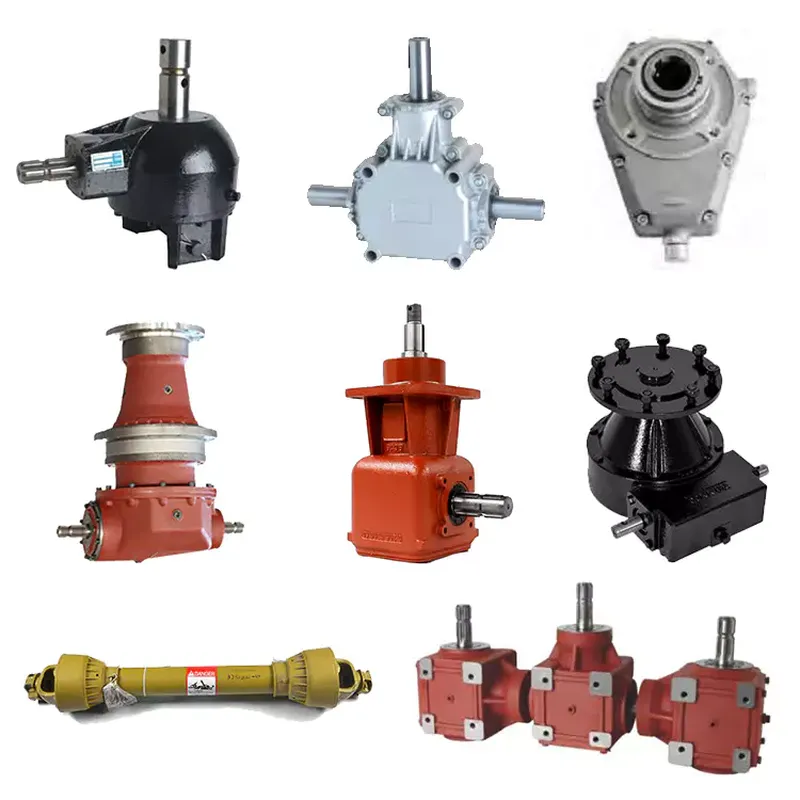
PTO shafts with safety guards, telescopic joints, and universal couplings enhance compatibility. Farm accessories like chains, sprockets, pulleys, couplings, and hydraulic cylinders ensure system integration. Whole machines such as seeders and harvesters optional with gearboxes emphasize one-stop supply.
- PTO shafts for power transfer.
- Chains and sprockets for durable drives.
- Hydraulic cylinders for lift control.
Full Series of Farm Gearboxes and One-Stop Accessories
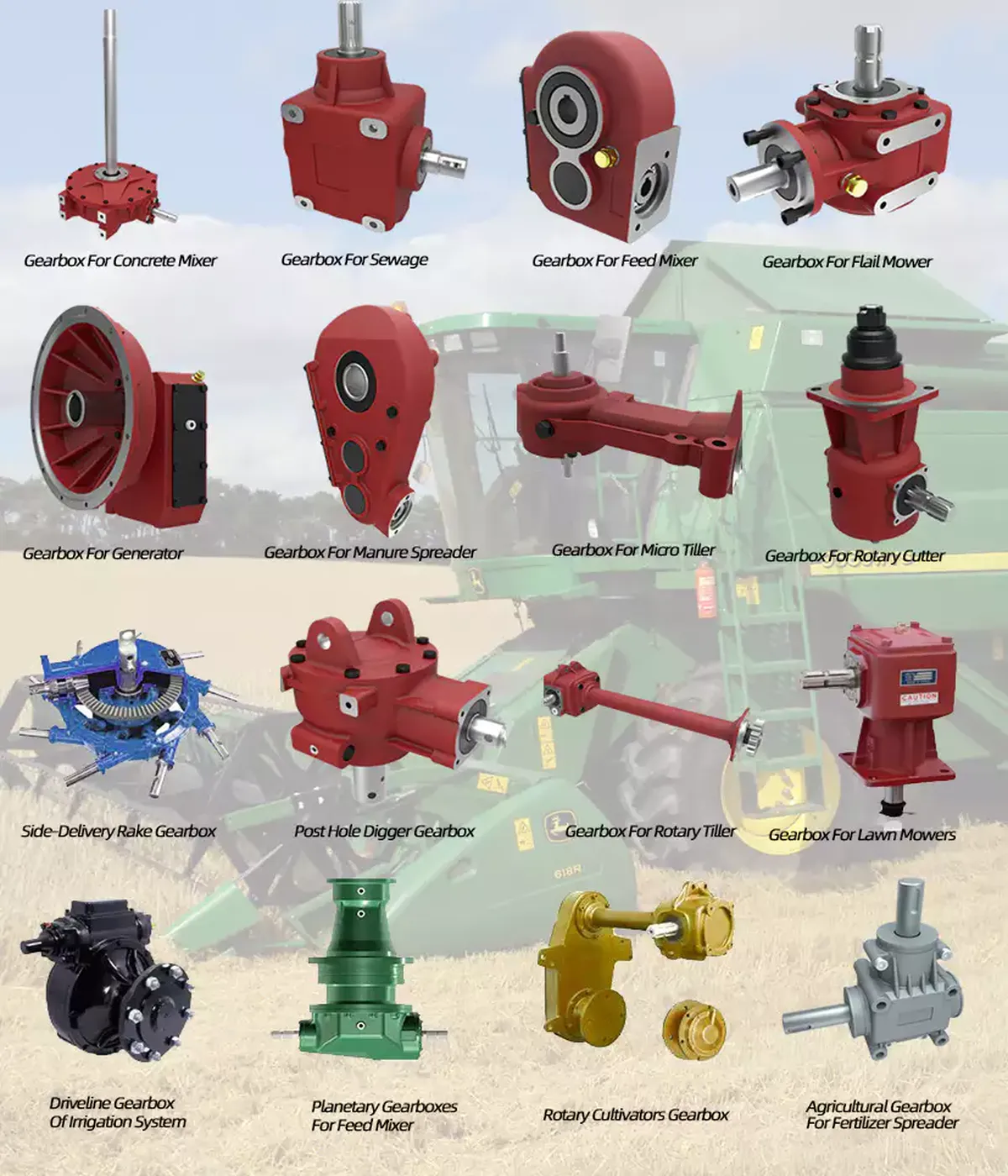
Our comprehensive lineup covers all agricultural needs, from tiller to harvester gearboxes, allowing bulk procurement. This sparks interest in streamlined sourcing, reducing logistics costs.
Contact and Call to Action
To inquire about conveyor gearboxes tailored for your operations, reach out today. Explore our full range at the home page for agricultural PTO solutions.
Working Principle
Gearboxes operate via meshed gears reducing speed and boosting torque. Input from PTO engages pinion, driving crown gear for 90-degree turn in bevel types. This principle suits conveyors for linear motion and elevators for vertical lift.
Process Flow
Material enters conveyor via hopper, gearbox drives belt, transferring to elevator where vertical buckets lift to discharge. Flow rates adjust via variable ratios.
Key Features and Advantages
Modular design for easy upgrades. High efficiency minimizes power draw. Robust construction withstands impacts.
- Custom ratios for specific loads.
- Low maintenance seals.
- Compatible with biofuels.
Why Choose Us
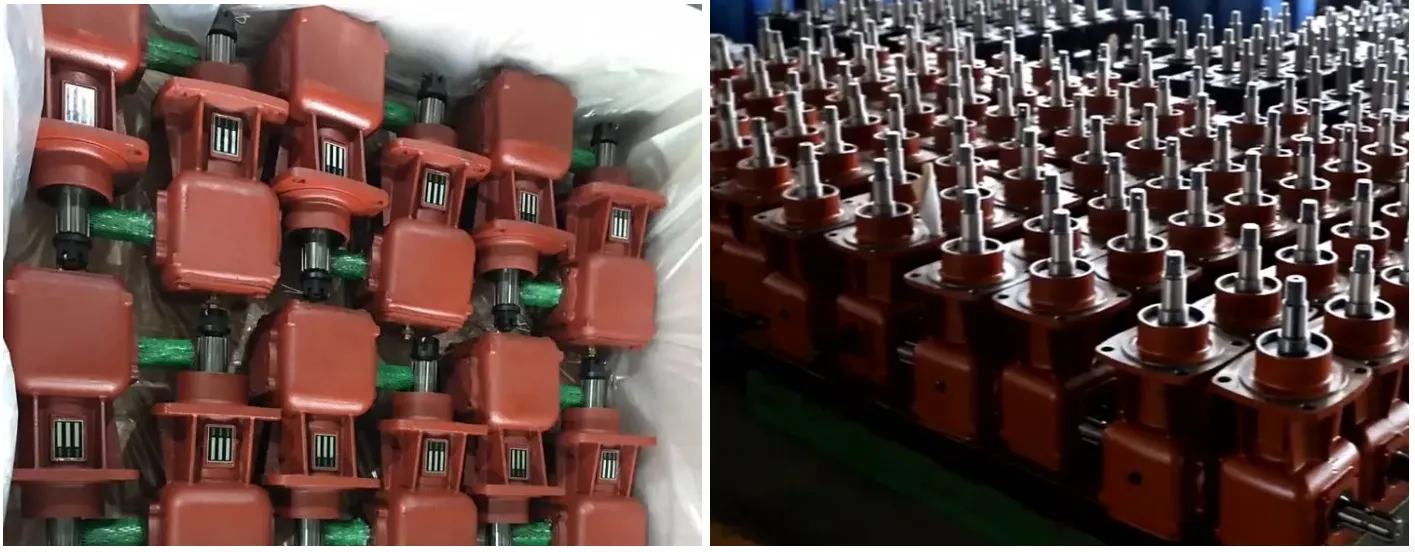
Proven performance in regional conditions, with tailored solutions for Argentine agriculture.