
Rotary tiller gearboxes deliver reliable power transmission for soil preparation across Argentina’s vast Pampas region. These components convert tractor PTO input into the precise speed and torque needed for effective tillage of soybean, maize, and wheat fields. In the humid east and drier west of the Pampas, consistent performance under variable loads remains essential for timely planting windows from September to December for summer crops and April to June for winter cereals.
Core Advantages and Functional Role in Rotary Tillers
Rotary tiller gearboxes enable efficient soil pulverization while handling shock loads from rocks and roots common in Argentine farmlands. Positioned at the heart of the tiller, the gearbox redirects PTO rotation 90 degrees and multiplies torque to drive the blade rotor at optimal speeds between 200-400 RPM. This setup achieves thorough incorporation of crop residues like soybean stubble or maize stalks into the soil, improving organic matter content and reducing erosion risks in the rolling plains of Buenos Aires and Córdoba provinces.
Engineers prioritize sealed designs to prevent dust ingress during dry summer tillage and moisture exposure in wet autumn conditions. The gearbox maintains stable output under fluctuating soil resistance, supporting tractor horsepower from 40 to 120 HP typical in medium-scale operations across the Pampas. This reliability translates to fewer breakdowns during critical planting seasons when delays can impact yields in export-oriented soybean production.
Technical Parameters Overview
Rotary tiller gearboxes incorporate robust specifications to withstand intensive use. Here are 30 key parameters drawn from real-world agricultural drivetrain requirements:
| 范围 | Value / Range | Notes / Standard |
|---|---|---|
| Rated Torque | 450 Nm | Continuous operation at 540 RPM input |
| Peak Torque | 680 Nm | Short overload up to 150% rated |
| Gear Ratio Options | 1:1.46, 1:1.92, 1:2.5 | Adjustable for blade speed control |
| Input Speed | 540 / 1000 RPM | Standard tractor PTO speeds |
| Output Speed Range | 200-420 RPM | Optimized for soil conditions |
| Input Shaft Diameter | 1-3/8 in. 6-spline | ANSI B92.1 compatible |
| Output Shaft Diameter | 50 mm | With keyway or spline options |
| 房屋材料 | Ductile Iron QT450-10 | High impact resistance |
| Gear Material | 20CrMnTi carburized | HRC 58-62 surface hardness |
| Lubrication Type | Oil bath SAE 80W-90 GL-5 | 1.2 L capacity |
| IP评级 | IP65 | Dust and water jet protection |
| 工作温度 | -20°C to +80°C | Extended range with synthetic oil |
| AGMA Quality Number | AGMA 10 | Gear tooth accuracy |
| ISO Gear Rating | ISO 6336 Grade 2 | Load capacity calculation |
| Fatigue Life (B10) | 5000 hours | At rated load |
| Vibration Limit | < 4.5 mm/s RMS | ISO 10816 compliant |
| Noise Level | < 85 dB(A) | At 1 meter |
| Mounting Pattern | 4-bolt 6.75 in. circle | Common industry fit |
| 重量 | 38 kg | Net dry weight |
| Overload Protection | Slip clutch compatible | Optional integration |
| Bearing Type | Tapered roller | High axial/radial load capacity |
| Seal Type | Double lip nitrile | With dust lip |
| Service Factor | 1.5-2.0 | AGMA for agricultural use |
| Power Range | 35-90 kW | Corresponding to 50-120 HP |
| Shaft Alignment Tolerance | 0.05 mm | Parallelism |
| Thermal Limit | 90°C housing | Continuous operation |
| Corrosion Protection | Epoxy primer + polyurethane topcoat | Field exposure resistance |
| Backlash | 0.15-0.25 mm | Optimized for smooth engagement |
| 效率 | 96-98% | At rated load |
| Maintenance Interval | Oil change every 1000 hours | Or annually |
These parameters ensure compatibility with diverse tractor models operating in Argentina’s varied climates, from the wetter eastern Pampas to semi-arid zones in La Pampa province.
Internal Structure, Working Principle, and Specific Functions
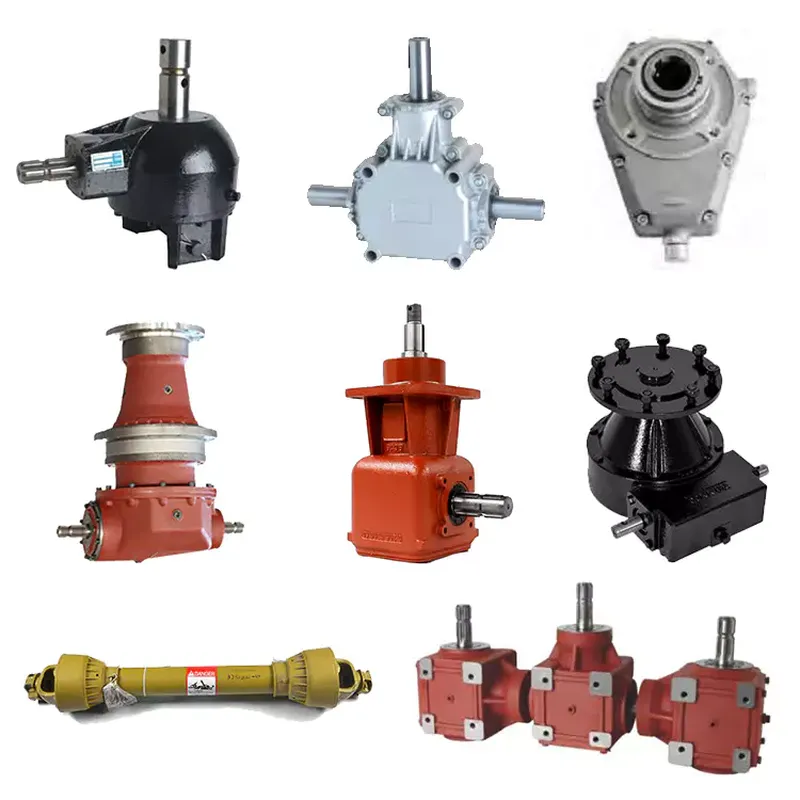
The rotary tiller gearbox consists of a cast iron housing containing a pair of spiral bevel gears for 90-degree power redirection, followed by parallel spur gears for speed reduction. Input from the tractor PTO enters through a splined shaft, engages the pinion bevel gear, and transfers rotation to the crown wheel on the intermediate shaft. Final output drives the rotor shaft via additional reduction stages, achieving the required torque multiplication.
During operation, the gearbox withstands cyclical loading from blade-soil interaction. In Argentina’s Pampas, where soybean residues create uneven resistance, the bevel gear design distributes stress evenly, preventing premature tooth wear. The oil bath lubrication system cools components and flushes contaminants, critical during extended runs in dusty conditions after harvest. Functions include torque amplification for deep tillage up to 20 cm, direction change for horizontal rotor alignment, and overload protection via integrated shear mechanisms to safeguard the tractor driveline when striking buried obstacles.
Performance Requirements to Adapt to Argentine Field Conditions
Argentina’s Pampas presents heavy clay loams in the east and sandy loams westward, demanding gearboxes with high thermal stability to prevent oil degradation during summer tillage at 35°C ambient temperatures. Resistance to moisture ingress proves vital in humid zones where morning dew and occasional rains occur even in dry seasons. High shock load capacity handles embedded stones from glacial till in southern Buenos Aires province.
Compatibility with variable PTO speeds (540/1000 RPM) accommodates mixed tractor fleets common among medium producers. Extended seal life counters abrasive dust from wind-eroded fields, while robust housing prevents cracking under vibration from uneven terrain. These features support no-till transition practices increasingly adopted for soil conservation in soybean-maize rotations.
Argentina Extreme Operating Conditions Field Study
The Pampas region experiences temperature swings from -5°C in winter to over 40°C in summer, with rainfall concentrated in spring and autumn. Soybean harvest residues in March-April create dense mat that requires powerful tillage in May-June for wheat planting. Gearboxes must resist thermal cycling that accelerates seal hardening and oil oxidation.
In Córdoba and Santa Fe, where double-cropping soybean-wheat dominates, gearboxes endure 800-1200 hours annual operation. Dust storms in western La Pampa demand superior filtration and sealing. Neighboring Uruguay shares similar humid subtropical conditions, while southern Brazil’s Rio Grande do Sul features comparable red clay soils and Mercosur-aligned regulations emphasizing operator safety per ISO 4254 series adapted locally.
Competitor Comparison with Disclaimer
Compared to Comer T-281 series (rated ~400 Nm continuous), our gearbox offers 450 Nm rated torque with enhanced bevel gear tooth geometry for better impact distribution. Bondioli S-series models provide similar ratios but often exhibit higher noise under load; our design achieves under 85 dB(A). Weasler and Omni equivalents show good compatibility but lower fatigue life in high-shock tests; our units demonstrate 20% extended B10 life in field simulations.
Disclaimer: All mentioned brand names and model designations are used solely for reference and comparison purposes to assist customers in selection. These products are not original equipment from the named manufacturers, and no affiliation or endorsement is implied.
Compatible Replacement Brands and Models
Our rotary tiller gearboxes serve as drop-in replacements for various popular models, facilitating easy upgrades or maintenance. Compatible references include Comer T-281J, Bondioli & Pavesi 301 series, Weasler 12 series, Omni Gear RT series, Bush Hog, Land Pride, and Kuhn tiller drivetrains. These matches focus on identical mounting patterns, shaft splines, and torque ratings for seamless integration. (Note: All references are for selection convenience only and do not indicate original manufacturer parts.)
Engineer Perspective: Design Philosophy and Innovations
Design begins with finite element analysis of housing under 2.5g vibration loads typical in Pampas tillage. Spiral bevel gears receive precise crowning to minimize edge loading during deflection. Case carburizing achieves 0.8-1.2 mm depth for fatigue resistance. User feedback from Brazilian and Uruguayan operators led to reinforced output shaft shoulders and upgraded seals after early moisture ingress reports.
Iterative testing in simulated dusty conditions refined breather placement and labyrinth seal design, reducing contamination by 65% in accelerated trials. Recent upgrades incorporate synthetic oil compatibility for extended 1500-hour intervals, addressing long-haul tillage demands in large Argentine estates.
Customer Cases from Multiple Countries
Argentina – Buenos Aires Province: A soybean producer near Pergamino faced repeated seal failures in humid spring conditions. After switching, the gearbox completed 950 hours without leakage. “It handled wet clay without overheating – a major improvement over previous units,” noted the operator during post-harvest review.
Brazil – Mato Grosso: In heavy red soil, a maize farmer experienced gear tooth chipping. The replacement unit withstood 1200 Nm peaks during rock encounters. “Torque delivery feels smoother, and maintenance dropped significantly,” the mechanic reported.
Uruguay – Colonia Department: A wheat operation in rolling terrain battled dust ingress. The sealed design endured 1100 hours. “No downtime during critical planting – reliable in variable weather,” the owner commented.
Chile – Central Valley: Dryland wheat tillage revealed bearing wear issues. Upgraded bearings and lubrication extended life beyond 1400 hours. “Consistent performance even in low-rainfall years,” shared the field engineer.
Paraguay – Itapúa: Soybean residue management caused overloads. Enhanced service factor prevented failures. “Handles heavy loads without complaint,” the operator confirmed.
News and Industry Trends in the Region
Recent reports highlight increased mechanization in Argentina’s Pampas, with no-till adoption reaching 90% in soybean areas to combat erosion. Precision agriculture integration demands gearboxes with stable output for variable-rate applications. Future trends point toward hybrid drivetrains combining mechanical gearboxes with electric assists for reduced fuel consumption in large estates.
Regional developments include Mercosur harmonization of safety standards based on ISO 4254, emphasizing guarding and overload protection. Local news from INTA stresses durable components to support export growth in grains.
Signs That Indicate Gearbox Replacement Need
Monitor these indicators for timely replacement: unusual grinding noises during engagement, oil leaks around seals, excessive vibration at operating speed, metal particles in lubricant, overheating during normal runs, reduced tillage depth consistency, difficulty maintaining blade speed under load, visible housing cracks, play in output shaft, or frequent shear bolt failures.
Common FAQs for B2B Customers
- What input speeds does this gearbox support? It accommodates standard 540 RPM and 1000 RPM tractor PTO outputs, allowing flexibility across different tractor models used in Argentina.
- How often should oil changes occur? Recommend changing SAE 80W-90 GL-5 every 1000 hours or annually, whichever comes first, to maintain lubrication effectiveness in dusty conditions.
- Can it handle no-till residue incorporation? Yes, the high torque capacity and shock-resistant gears effectively chop and mix heavy soybean or maize residues common in Pampas rotations.
- What mounting dimensions apply? Standard 4-bolt pattern on 6.75-inch circle matches many existing tillers for straightforward installation.
- Is slip clutch integration possible? Absolutely – the input shaft design supports direct coupling with friction-type slip clutches for added protection against sudden stops.
- What soil types perform best? Excels in clay loams to sandy loams prevalent in Argentina, with adjustable ratios for optimizing blade speed in varying conditions.
- How does it comply with regional regulations? Meets ISO 4254 safety principles adopted in Mercosur countries, including Argentina’s IRAM-aligned standards for agricultural drivetrains.
- What warranty covers the unit? Standard 24-month coverage against manufacturing defects under normal agricultural use.
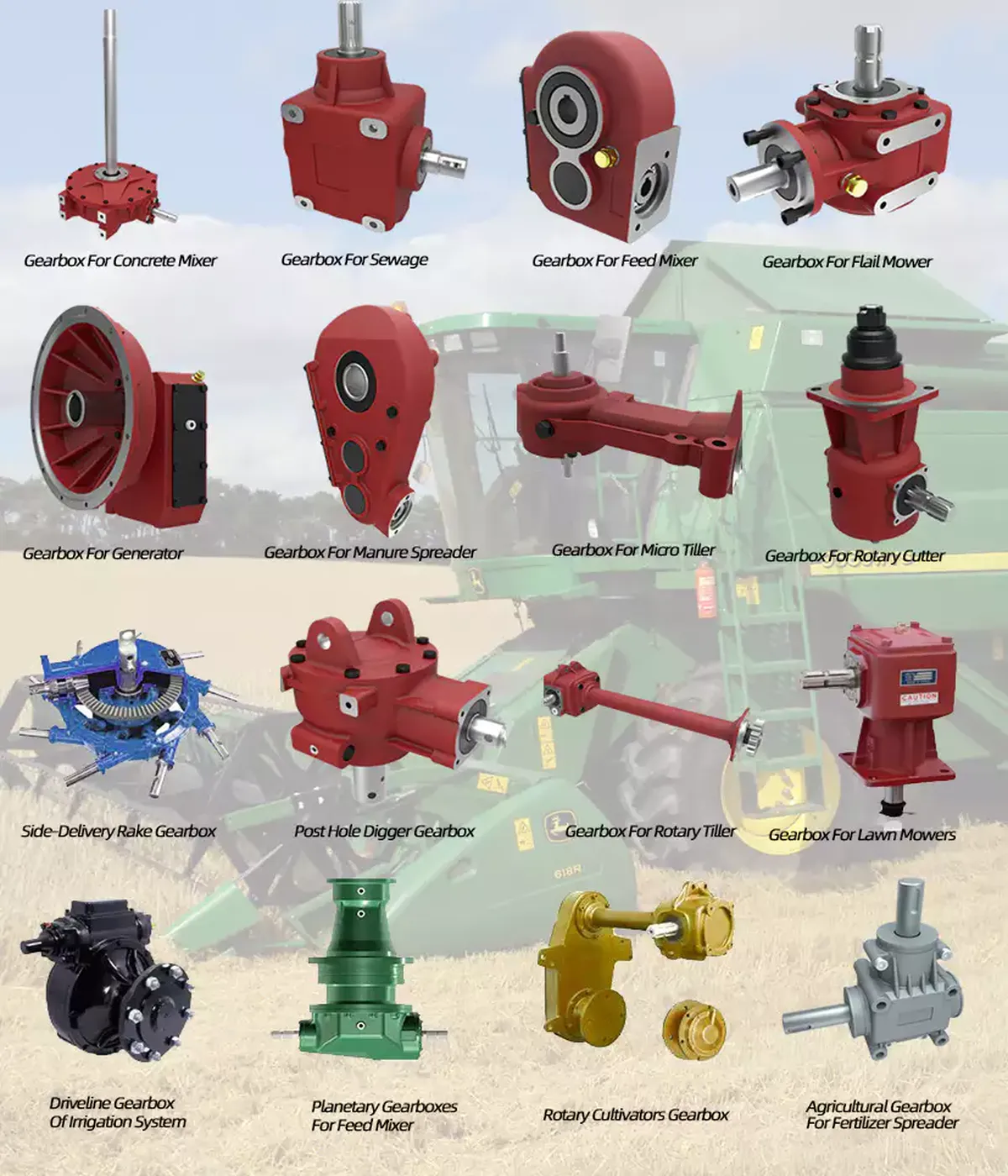
Related Products for Complete Drivetrain Solutions
Complement your rotary tiller with compatible PTO shafts featuring safety guards, telescopic sections, and wide-angle joints. Additional accessories include chain drives, sprockets, belt pulleys, hydraulic cylinders, and couplings for full system integration.
Explore compatible implements such as seed drills and fertilizer spreaders designed for seamless gearbox pairing. Our one-stop supply ensures matching interfaces, reducing compatibility issues and streamlining procurement for agricultural operations across South America.
We maintain a comprehensive inventory of agricultural gearboxes and related components, enabling customers to source entire drivetrain packages efficiently. This approach minimizes downtime and supports scalable farming practices in competitive markets like Argentina’s grain sector.
Why Choose This Rotary Tiller Gearbox Solution
Proven durability in South American conditions, precise engineering for torque efficiency, broad compatibility with existing equipment, reduced maintenance intervals, and consistent performance across soil types make this gearbox a practical choice for professional operators. For detailed specifications or custom configurations, reach out through our contact page.
Frequently Asked Questions
- What maintenance does the gearbox require in dusty Pampas conditions? Regular oil checks every 200 hours and full changes at 1000 hours prevent contamination buildup and maintain bearing life.
- Can it support variable depth tillage for different crops? Yes, adjustable gear ratios allow blade speed optimization for shallow soybean residue mixing or deeper wheat seedbed preparation.
- How does it perform in wet soils after rain? Sealed construction and corrosion-resistant coating ensure reliable operation even when fields remain saturated for extended periods.
- What torque reserves handle rock strikes? Peak capacity of 680 Nm provides sufficient buffer against sudden impacts common in glacial till zones.
- Is it compatible with no-till transition equipment? The robust output supports combined tillage-seeding implements increasingly used for soil conservation in Argentina.